

Winter on the Sinyaya River. The Sinyaya Pillars
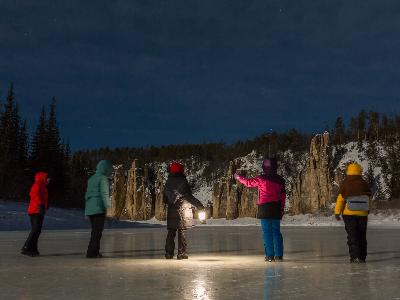
The Sinyaya Pillars can also be visited in winter!
The Sinyaya River, being one of Nature’s greatest creations, rightfully belongs to the list of the most beautiful places on our planet.
Our Yakutian winter allows for a more comfortable visit to these unique sites compared to summer. We use a "Trekol" low-pressure tire all-terrain vehicle. Visits to the Sinyaya Pillars are conducted from the Uorannakh tourist base.
The Sinyaya Pillars are rock formations that reach heights of up to 120 meters above the river level, composed of Cambrian limestone. The formation of the rocks that make up this natural monument dates back to 540-530 million years ago. Geologically, the cliffs represent an example of early Paleozoic sedimentary rock formations. In ancient times, a shallow warm sea washed over the ancient Siberian continental area at the foot of these cliffs. The formation of the Sinyaya Pillars as a landform, as well as the Lena Pillars in general, dates back to about 400,000 years ago, which is relatively recent in geological terms.
The territory of the Siberian platform underwent gradual uplift, resulting in the formation of faults and the creation of deep river valleys. This led to the activation of karst processes, which, along with ongoing erosional weathering, produced such whimsical and diverse forms of cliffs composed of carbonate rocks. Along the Sinyaya River, there are a total of 37 groups of cliffs spread over 130 kilometers up to the river’s mouth. The length of each group ranges from 100 meters to 4 kilometers. During the tour, tourists will see 10-11 groups of cliffs, have the opportunity to walk beneath the cliffs, and climb the group of cliffs known as "Skala Lyubvi" (Love Rock). The Andreevskaya Petroglyph (Opuokhallakh-Khaya according to A. A. Savvin) is located on the left bank of the Sinyaya River, 133 kilometers from its mouth and 3.5 kilometers downstream from the Matta River.
This monument features nine panels with 276 drawings (anthropomorphic and zoomorphic figures, faces, birds, etc.), created using ochre of various colors. The cliffs with the drawings are eroding, but their condition is still good. Beneath the 9th panel, a two-layer altar has been uncovered: the first layer contains a forged nail and small-caliber cartridges; the second layer includes four flint blade-like plates, an end scraper, and a fragment of pottery from the Imyakhtakh period. The monument is dated to the 2nd-1st millennia BC to the 1st millennium AD. Mount Kyrtas is a high sandy ravine, with a length of 3 kilometers. For this route, you can rent winter suits and footwear from us.
Our Yakutian winter allows for a more comfortable visit to these unique sites compared to summer. We use a "Trekol" low-pressure tire all-terrain vehicle. Visits to the Sinyaya Pillars are conducted from the Uorannakh tourist base.
The Sinyaya Pillars are rock formations that reach heights of up to 120 meters above the river level, composed of Cambrian limestone. The formation of the rocks that make up this natural monument dates back to 540-530 million years ago. Geologically, the cliffs represent an example of early Paleozoic sedimentary rock formations. In ancient times, a shallow warm sea washed over the ancient Siberian continental area at the foot of these cliffs. The formation of the Sinyaya Pillars as a landform, as well as the Lena Pillars in general, dates back to about 400,000 years ago, which is relatively recent in geological terms.
The territory of the Siberian platform underwent gradual uplift, resulting in the formation of faults and the creation of deep river valleys. This led to the activation of karst processes, which, along with ongoing erosional weathering, produced such whimsical and diverse forms of cliffs composed of carbonate rocks. Along the Sinyaya River, there are a total of 37 groups of cliffs spread over 130 kilometers up to the river’s mouth. The length of each group ranges from 100 meters to 4 kilometers. During the tour, tourists will see 10-11 groups of cliffs, have the opportunity to walk beneath the cliffs, and climb the group of cliffs known as "Skala Lyubvi" (Love Rock). The Andreevskaya Petroglyph (Opuokhallakh-Khaya according to A. A. Savvin) is located on the left bank of the Sinyaya River, 133 kilometers from its mouth and 3.5 kilometers downstream from the Matta River.
This monument features nine panels with 276 drawings (anthropomorphic and zoomorphic figures, faces, birds, etc.), created using ochre of various colors. The cliffs with the drawings are eroding, but their condition is still good. Beneath the 9th panel, a two-layer altar has been uncovered: the first layer contains a forged nail and small-caliber cartridges; the second layer includes four flint blade-like plates, an end scraper, and a fragment of pottery from the Imyakhtakh period. The monument is dated to the 2nd-1st millennia BC to the 1st millennium AD. Mount Kyrtas is a high sandy ravine, with a length of 3 kilometers. For this route, you can rent winter suits and footwear from us.
- all group transfers;
- meeting at the airport on the day of tour start;
- hot meals during the tour;
- meals at the recreation center;
- visit to the Sinyaya Natural Park;
- guide services.
Meals during the transfer in roadside cafes.
-
down jacket for low temperatures;
-
warm sweater;
-
insulated pants;
-
woolen thermal underwear;
-
warm thermal underwear;
-
sports hat with dense material;
-
balaclava mask with dense material;
-
mittens from natural fur;
-
warm gloves;
-
woolen socks;
-
warm socks;
-
warm boots with natural fur;
-
natural felt insoles for shoes;
-
thermos (optional);
-
individual first-aid kit;
-
a towel;
-
personal hygiene items;
-
powerbank (portable battery) / solar panel.
-
winter suit (comfort up to -35 -40 degrees Celsius). The suit can be worn as an additional warm layer on top of your clothes;
-
valenki (felt boots).