

The Sinyaya River. The Sinyaya Pillars
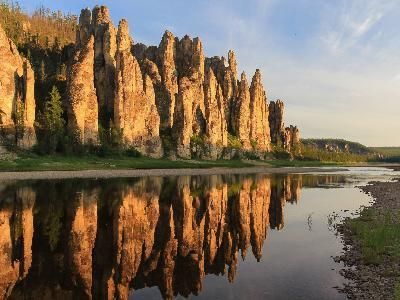
Rock formations, the height of which reaches 180 m above the river level, are composed of Cambrian limestone.
Sinyaya (Yakut Сиинэ) is a river in Yakutia, a left tributary of the Lena River. Length - 597 km, basin area - 30,900 sq km.
It originates and flows along the Lena Plateau in three districts of the republic - Verkhnevilyuysky, Gorny and Khangalassky.
In the lower reaches there is a nature monument, the Sinyaya Pillars.
The main tourist route starts fr om the area of the left tributary Matta. Below Matta in 3.5 km there are the first rocks on which petroglyphs of ancient people were found.
In total on the Sinyaya River we counted 37 groups of rocks and this figure is now official. The rocks are located along the bank, in places wh ere the river has eroded the rock. The length of the rocks is from several hundred meters to four kilometers. The cliffs are shaped like pillars that reach a height of 180 meters.
Geologically, the cliffs are a sample of early Paleozoic sedimentary rock formations. In ancient times at the foot of them there was a shallow warm sea, which washed the ancient Siberian continental area.
The formation of the Sinyaya Pillars as a form of relief, as well as the Lena Pillars in general, date back to about 400 thousand years ago, i.e. a relatively recent geological time. The territory of the Siberian Craton was subjected to gradual uplift, which resulted in the emergence of faults and the formation of deep river valleys. This led to the activation of karst processes, which, along with ongoing erosion weathering, gave rise to such bizarre and diverse forms of rocks composed of carbonate rocks.
The rivers Matta, Tas Khanda, Kyra Tas, Nachabyl, Mundukta, Unkur and Billekh flow into the river.
Rock paintings were found in three places.
It originates and flows along the Lena Plateau in three districts of the republic - Verkhnevilyuysky, Gorny and Khangalassky.
In the lower reaches there is a nature monument, the Sinyaya Pillars.
The main tourist route starts fr om the area of the left tributary Matta. Below Matta in 3.5 km there are the first rocks on which petroglyphs of ancient people were found.
In total on the Sinyaya River we counted 37 groups of rocks and this figure is now official. The rocks are located along the bank, in places wh ere the river has eroded the rock. The length of the rocks is from several hundred meters to four kilometers. The cliffs are shaped like pillars that reach a height of 180 meters.
Geologically, the cliffs are a sample of early Paleozoic sedimentary rock formations. In ancient times at the foot of them there was a shallow warm sea, which washed the ancient Siberian continental area.
The formation of the Sinyaya Pillars as a form of relief, as well as the Lena Pillars in general, date back to about 400 thousand years ago, i.e. a relatively recent geological time. The territory of the Siberian Craton was subjected to gradual uplift, which resulted in the emergence of faults and the formation of deep river valleys. This led to the activation of karst processes, which, along with ongoing erosion weathering, gave rise to such bizarre and diverse forms of rocks composed of carbonate rocks.
The rivers Matta, Tas Khanda, Kyra Tas, Nachabyl, Mundukta, Unkur and Billekh flow into the river.
Rock paintings were found in three places.