

The Lena River
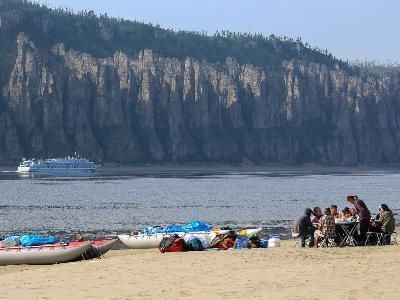
The Lena River is the tenth longest river in the world. It is 4,400 km long and the area of its watershed is 2,490,000 sq km. The Lena flows through the permafrost zone, dividing Yakutia into two halves.
The Yakut name for the river is Элиэнэ which means ‘wide water that has spread over a large area’. The river flows into the Laptev Sea. The length of the river is 4,430 km (officially 4,400 km).
The largest tributaries of the Lena River are the Vitim, Olekmа, Aldan, and Vilyuy rivers.
The head of the Lena is located in the Baikal Mountains at an altitude of 1,470 meters above sea level. It is 10 km fr om there to Lake Baikal. Coordinates: 54°0′51.12″ S, 108°4′16.76″ E.
The Lena River is the only river on Earth that flows entirely through the territory of permafrost.
Like all major rivers in Siberia, the Lena River flows northward, emptying into the Laptev Sea, a marginal sea of the Arctic Ocean. In a way, it can be considered a pioneer: after the melting of the glacier and the formation of flora and fauna, this river was one of the first to carve a path to the sea, exploring the vast taiga expanses of Siberia.
‘Lena’ has nothing to do with a female name; it originates from the Tungus-Manchu language Evenki Елю-Эне which means ‘big river’. The Evenki hydronym was applied by the river’s discoverer, the Russian explorer Pyanda, who, between 1619 and 1623, explored the river, traveling downstream from the modern area of Kirensk to Yakutsk.
History of the Lena River
The exploration of the Lena banks by Cossacks began in 1619 when explorers established the Yenisei Ostrog, which became a point for further expeditions to the Lena and Baikal. By that time, rumors about the “big river”, the banks of which were rich in fur-bearing animals, had long circulated among people. Therefore, with the appearance of this “outpost”, they immediately set out to find it. They approached the river from the north, via the Lower Tunguska to Vilyuy, and from the south - from Yeniseisk. The discovery of the Lena led to a rapid penetration into Yakutia. Three ostrogs were built. In 1632, the centurion of the Yenisei Cossacks, Pyotr Beketov, founded the Yakutsk (Lena) Ostrog, which became a base for expeditions eastward to the Pacific Ocean and southward to the Aldan and Amur rivers. In 1634, Vilyuysk was founded, and in 1635, Olekminsk.
In 1643, the Lena Ostrog was moved to a new, more convenient location in the Tuymaada Valley, which had long been settled by the Yakuts, and at that time it received city status and the name Yakutsk. Yakutsk is the largest city on the banks of the Lena River. For many centuries, it has been a base for the study and exploration of Siberia. From here, explorers such as Dezhnev, Atlasov, Poyarkov, Khabarov, and others set out on their journeys. Over time, notable figures such as Bering, the Laptev brothers, and Chereuskin visited Yakutsk.
In addition to Yakutsk, there are five cities located along the Lena River: Ust-Kut, Kirensk, Lenskiy, Olekminsk, and Pokrovsk. They play an important role as transport hubs, including key river ports. The most famous of these, Osetrovo in Ust-Kut, is the largest river port in Russia. It is the only port in the entire Lena basin connected to the railway, which is why it is called the “Gateway to the North”. The largest ports of the Lena’s tributaries are Bodaybo (on the Vitim River), Khandyga, and Dzhebariki-Khaya (on the Aldan River).
The Lena remains a vital route in Siberia. It is significantly used for northern supply deliveries. The beginning of navigation on the Lena is considered to be the Kachug pier, but not all sections of the river are navigable for large vessels until the Vitim River flows into the Lena. However, for the rest of its length, the Lena provides excellent conditions for water transport. The navigation period is limited in different sections of the river, ranging from 125 to 170 days.
The Lena flows through the permafrost zone, so both it and its main tributaries are primarily fed by melting snow and rainwater. The water level rises during flooding by 6-8 meters in the upper reaches and up to 10 meters in the lower reaches. The spring ice breakup turns into a powerful force and is often accompanied by large ice jams. Such jams are characteristic of rivers wh ere the ice breaks up from the top down.
During freezing, ice formations occur on the river, which sometimes return certain sections of the river to a glacial period. This happens when ice forms on the bottom, displacing the unfrozen water upwards. Gradually, it grows due to the water freezing on top, resulting in the ice formation rising several meters above the river level. The largest ice formations can stretch for tens of kilometers, turning into a kind of dam.
The main tributaries of the Lena are the Sinya, Vitim, Aldan, Nyuya, Olekma, Vilyuy, Kirenga, Chuya, and Molodo rivers.
Interesting facts
Text: https://news.ykt.ru/article/88588
The largest tributaries of the Lena River are the Vitim, Olekmа, Aldan, and Vilyuy rivers.
The head of the Lena is located in the Baikal Mountains at an altitude of 1,470 meters above sea level. It is 10 km fr om there to Lake Baikal. Coordinates: 54°0′51.12″ S, 108°4′16.76″ E.
The Lena River is the only river on Earth that flows entirely through the territory of permafrost.
Like all major rivers in Siberia, the Lena River flows northward, emptying into the Laptev Sea, a marginal sea of the Arctic Ocean. In a way, it can be considered a pioneer: after the melting of the glacier and the formation of flora and fauna, this river was one of the first to carve a path to the sea, exploring the vast taiga expanses of Siberia.
‘Lena’ has nothing to do with a female name; it originates from the Tungus-Manchu language Evenki Елю-Эне which means ‘big river’. The Evenki hydronym was applied by the river’s discoverer, the Russian explorer Pyanda, who, between 1619 and 1623, explored the river, traveling downstream from the modern area of Kirensk to Yakutsk.
History of the Lena River
The exploration of the Lena banks by Cossacks began in 1619 when explorers established the Yenisei Ostrog, which became a point for further expeditions to the Lena and Baikal. By that time, rumors about the “big river”, the banks of which were rich in fur-bearing animals, had long circulated among people. Therefore, with the appearance of this “outpost”, they immediately set out to find it. They approached the river from the north, via the Lower Tunguska to Vilyuy, and from the south - from Yeniseisk. The discovery of the Lena led to a rapid penetration into Yakutia. Three ostrogs were built. In 1632, the centurion of the Yenisei Cossacks, Pyotr Beketov, founded the Yakutsk (Lena) Ostrog, which became a base for expeditions eastward to the Pacific Ocean and southward to the Aldan and Amur rivers. In 1634, Vilyuysk was founded, and in 1635, Olekminsk.
In 1643, the Lena Ostrog was moved to a new, more convenient location in the Tuymaada Valley, which had long been settled by the Yakuts, and at that time it received city status and the name Yakutsk. Yakutsk is the largest city on the banks of the Lena River. For many centuries, it has been a base for the study and exploration of Siberia. From here, explorers such as Dezhnev, Atlasov, Poyarkov, Khabarov, and others set out on their journeys. Over time, notable figures such as Bering, the Laptev brothers, and Chereuskin visited Yakutsk.
In addition to Yakutsk, there are five cities located along the Lena River: Ust-Kut, Kirensk, Lenskiy, Olekminsk, and Pokrovsk. They play an important role as transport hubs, including key river ports. The most famous of these, Osetrovo in Ust-Kut, is the largest river port in Russia. It is the only port in the entire Lena basin connected to the railway, which is why it is called the “Gateway to the North”. The largest ports of the Lena’s tributaries are Bodaybo (on the Vitim River), Khandyga, and Dzhebariki-Khaya (on the Aldan River).
The Lena remains a vital route in Siberia. It is significantly used for northern supply deliveries. The beginning of navigation on the Lena is considered to be the Kachug pier, but not all sections of the river are navigable for large vessels until the Vitim River flows into the Lena. However, for the rest of its length, the Lena provides excellent conditions for water transport. The navigation period is limited in different sections of the river, ranging from 125 to 170 days.
The Lena flows through the permafrost zone, so both it and its main tributaries are primarily fed by melting snow and rainwater. The water level rises during flooding by 6-8 meters in the upper reaches and up to 10 meters in the lower reaches. The spring ice breakup turns into a powerful force and is often accompanied by large ice jams. Such jams are characteristic of rivers wh ere the ice breaks up from the top down.
During freezing, ice formations occur on the river, which sometimes return certain sections of the river to a glacial period. This happens when ice forms on the bottom, displacing the unfrozen water upwards. Gradually, it grows due to the water freezing on top, resulting in the ice formation rising several meters above the river level. The largest ice formations can stretch for tens of kilometers, turning into a kind of dam.
The main tributaries of the Lena are the Sinya, Vitim, Aldan, Nyuya, Olekma, Vilyuy, Kirenga, Chuya, and Molodo rivers.
Interesting facts
- The Lena River is the tenth longest among the largest rivers in the world. In its upper, swift-flowing reaches, the Lena has sculpted whimsical forms of ‘fortress walls’ in the rocks over thousands of years, like a modernist sculptor. The enormous, majestic cliffs known as the Lena Pillars rise along its banks just above Pokrovsk, reaching heights of 200-300 meters.
- The freezing of the Lena in certain sections begins from the bottom. Sometimes, small pieces of ice rise to the surface and float downstream. This phenomenon is called ‘shuga’. There are times when a large amount of shuga completely fills the riverbed, forming jams.
- Not far from the village of Kachug, along the banks of the Lena, there are unique rock art monuments known as the Shishkin Petroglyphs. The complex contains over 3,000 drawings, stretching over 3.5 km. The images of animals, journeys, battles, festivals, and more were created from the late Neolithic period to the 19th century.
- On the right bank of the Lena, sandy dunes stretch for about 1 km, creating a complete illusion of a hot and arid landscape, disrupted only by the surrounding pines. Many theories about the origin of this phenomenon exist, but none have been accepted.
- In 1982, traces of ancient human habitation were discovered in the area of the Lena Pillars, reviving the hypothesis of the non-tropical origin of humans. Although scientists have different estimates regarding the age of these Paleolithic sites, the undeniable fact remains that the territory of Yakutia was inhabited by representatives of the genus Homo at least three hundred thousand years ago. Russian scientist Yu. A. Mochanov even dates the age of the sites to 1.8 million years, placing them alongside the oldest human sites found in the Olduvai Gorge in Africa.
- In 2015, a three-meter monument to the river named ‘The Beautiful Lena’ was erected in the city of Olekminsk in the Olekminsk District.
Text: https://news.ykt.ru/article/88588