

Emegettekh Ritual Place. The Emegettekh Cave
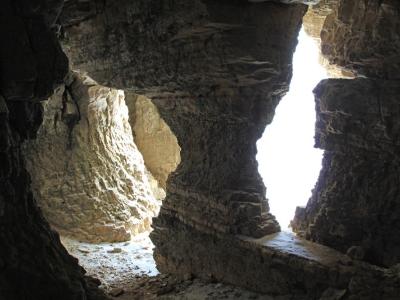
It is the first recorded cave in Eastern Siberia. The Nozdrevataya Cave, which got its name from the depressions on the walls, was described by Irkutsk surveyor Anton Losev in 1875.
In 2013, an expedition led by Alexander Osintsev fr om the Arabika speleological club (Irkutsk) conducted a more thorough examination of the cave. They managed to capture small passages branching off fr om the main corridor of the cave. The current length of the cave is 33 meters. The entrance to the grotto is approximately 8 meters high. The Yakut name Эмэгэттээх means that shamanic rituals were previously conducted here. Emeget is an shamanic item in which he places their spirit. With the help of the emeget, the shaman visits otherworldly realms.
Shamanic rituals are still conducted here to this day, of which we have witnessed more than once.
The cave itself features a rock painting in the form of a centipede. Locals call it Luo (Dragon). The drawing is made with black paint.
To the right of the cave, at a height of approximately 15 meters, there is an image of a shaman painted with red ochre. According to shamans, the three circles drawn above the shaman represent the three worlds: the Lower, Middle, and Upper, while the nine dashes represent the nine heavens wh ere our deities reside.
Further towards the mouth of the Big Keteme River, several more images are painted on the rock, but time has blurred the boundaries of the drawings, making them indistinct.
In 2012, a resident of the village of Tumul, Mikhail Stepanov, shared the following story:
“In 1961, when I was in elementary school in the village of Tumul, the teacher took us on a hike to the caves. In the Emegettekh area, in a large cave wh ere rituals were once performed, in one of the crevices of the cave, we saw a birch bark coffin of a child.’
From correspondence with Alexander Osintsev:
It is evident that the second cave (Nozdrevataya) was also used by local residents (Evenks, Yakuts???) for ritual purposes. Otherwise, why did Losev pay attention to it? After all, there are other caves nearby. Obviously, someone told him about this cave. This means that there must be an ancient layer of folklore, legends, shamanic invocations, etc., associated with this cave. We just need to find all of this. The caves should also have local names that have been preserved through the ages.
The second point that comes to mind in this situation is that we need to organize and clean the rocks near the cave of modern inscriptions and trash. It definitely deserves this. And it wouldn’t take much effort - everything could be done in one day.
The third point is that it might be worth installing a memorial plaque or at least a banner near the cave, telling the history of this site.
That’s what I think… But it’s up to you, the locals.”
Expeditions: http://www.youtube.com/watch?v=Y7gPGpmn7q8&feature=youtu.be
Shamanic rituals are still conducted here to this day, of which we have witnessed more than once.
The cave itself features a rock painting in the form of a centipede. Locals call it Luo (Dragon). The drawing is made with black paint.
To the right of the cave, at a height of approximately 15 meters, there is an image of a shaman painted with red ochre. According to shamans, the three circles drawn above the shaman represent the three worlds: the Lower, Middle, and Upper, while the nine dashes represent the nine heavens wh ere our deities reside.
Further towards the mouth of the Big Keteme River, several more images are painted on the rock, but time has blurred the boundaries of the drawings, making them indistinct.
In 2012, a resident of the village of Tumul, Mikhail Stepanov, shared the following story:
“In 1961, when I was in elementary school in the village of Tumul, the teacher took us on a hike to the caves. In the Emegettekh area, in a large cave wh ere rituals were once performed, in one of the crevices of the cave, we saw a birch bark coffin of a child.’
From correspondence with Alexander Osintsev:
It is evident that the second cave (Nozdrevataya) was also used by local residents (Evenks, Yakuts???) for ritual purposes. Otherwise, why did Losev pay attention to it? After all, there are other caves nearby. Obviously, someone told him about this cave. This means that there must be an ancient layer of folklore, legends, shamanic invocations, etc., associated with this cave. We just need to find all of this. The caves should also have local names that have been preserved through the ages.
The second point that comes to mind in this situation is that we need to organize and clean the rocks near the cave of modern inscriptions and trash. It definitely deserves this. And it wouldn’t take much effort - everything could be done in one day.
The third point is that it might be worth installing a memorial plaque or at least a banner near the cave, telling the history of this site.
That’s what I think… But it’s up to you, the locals.”
Expeditions: http://www.youtube.com/watch?v=Y7gPGpmn7q8&feature=youtu.be